
For most of the time pitched rooflights have existed, “opening” has meant the same thing: a hinge, a pane tilting up or out, and a gap around the edge where air gets in. It works, and it’s better than nothing, but it’s always been a compromise. The glass itself gets in the way of the opening it’s meant to create.
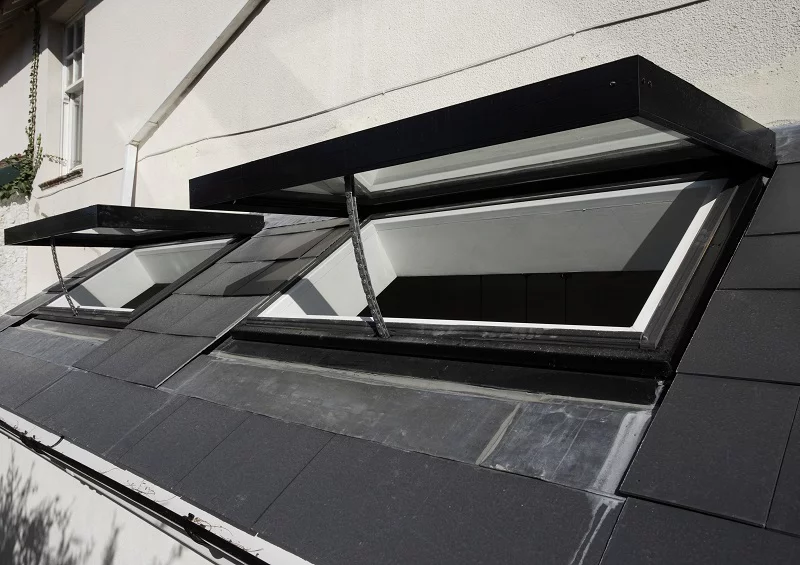
A fully opening rooflight does something different. Rather than tilting a pane across the aperture, the entire lid lifts clear of it. A standard opening Luxlite still leaves part of the aperture blocked by the tilted pane. A fully opening one doesn’t.
This piece looks at what changes when the whole lid opens, and how it works day to day
What “fully opening” actually means
A standard opening Luxlite® hinges along one edge, with the pane tilting up and out until the mechanism and frame stop it going further. The glass itself becomes part of the obstruction, blocking a share of the very opening it’s meant to create. You get a gap, not an opening.
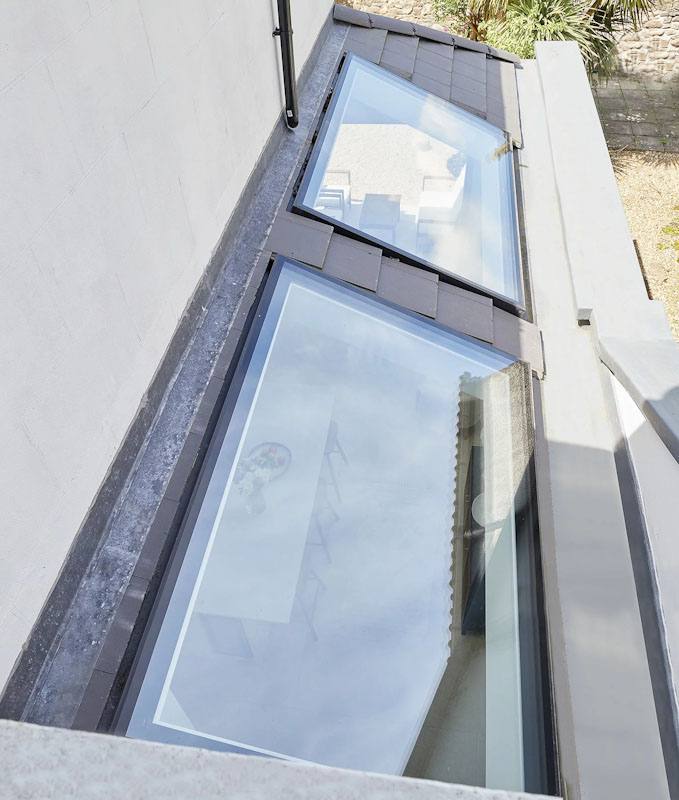
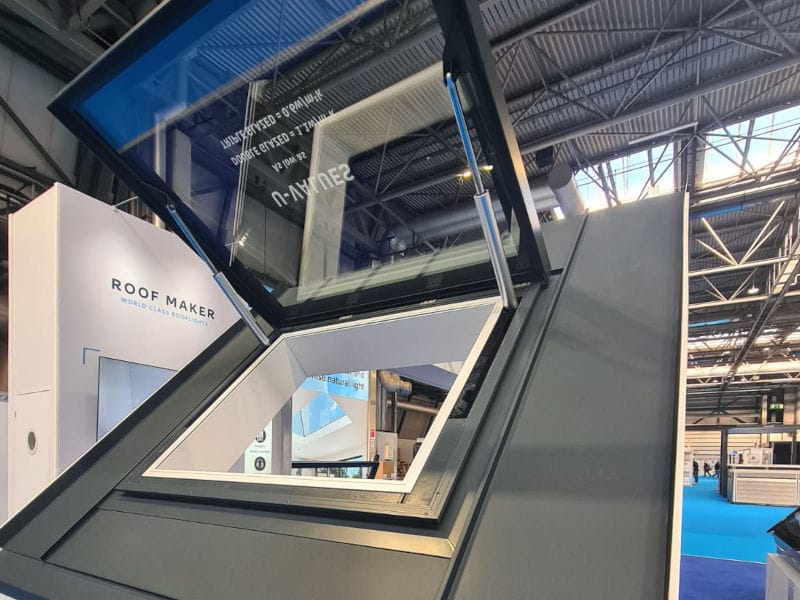
The Luxlite® Plus works differently. The entire lid lifts, hinged along the top edge, and reaches 88 degrees. That’s close enough to a right angle that the aperture becomes, in practical terms, an open hole in the roof rather than a window ajar. There’s no pane angled across the opening and nothing between the room and the sky. It’s operated at the press of a wall-mounted switch, so there’s no pole to find and no catch to reach for overhead.
It’s the same shift in thinking we set out in The Pitched Rooflight, Reconsidered: less roof, more sky. A hinged pane lets a pitched roof breathe a little. A lid that lifts clear lets it open.
Ventilation, properly done
Warm air rises, and in a pitched room it collects along the ridge line, the highest part of the slope. A rooflight set into that slope gives it a way out close to where it gathers, and our guide to stopping a glazed extension overheating in summer covers the physics behind it in more detail. What changes with a fully lifting lid is how much of that air can actually get out at once.
A tilted pane clears air through the gap around its edge, a fraction of the aperture, so the room vents slowly. A lid that lifts clear vents through the whole aperture instead. On a hot day, that’s the difference between a room that takes the edge off its heat and one that actually cools down.
It also changes how the room draws air. A narrow gap pulls in a thin stream from whatever’s nearest, usually the room immediately below it. A wider opening pulls through a much larger volume. Air moves across the whole room rather than just near the rooflight, and a loft room with windows or a door at a lower level gets a proper draw from one to the other, rather than a token breeze near the ceiling.
None of this needs the room to be large, or the rooflight oversized, to work. The limit isn’t the size of the glass. It’s the size of the gap, and a lid that lifts clear simply doesn’t leave one.
The view and the sense of access
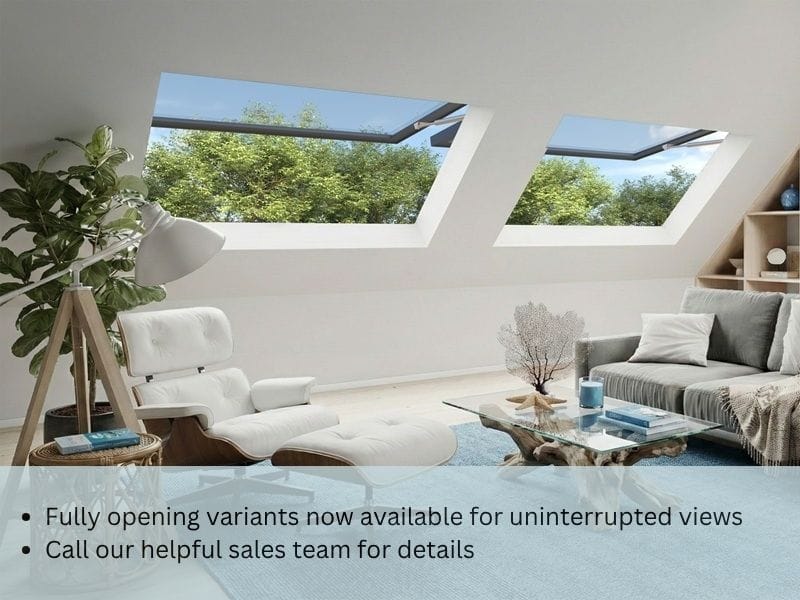
The Luxlite® range appears frameless from inside, since the frame is concealed and the glass runs edge to edge. With the lid lifted on a Luxlite Plus, that view changes again. There’s no pane between the room and the sky at all, just an open aperture. It’s the point where the rooflight stops being something you look through and becomes something you look out of.
That matters most in the rooms where a rooflight is often the only way to see the sky directly. A loft bedroom with a pitched ceiling rarely has a wall window placed for a clear upward view, so the rooflight is doing that job on its own. With the lid open, it does the job properly, with air, light and an actual gap to the outside, rather than a sealed pane with a view through it.
The Luxlite Plus also gives direct access to the roof space when the lid is open. That’s useful in its own right, separately from anything to do with ventilation or the view, for reaching the roof to clear debris from around the aperture, for example.
Operation in practice
A Luxlite Plus opens and closes at the press of a wall-mounted switch, inside the room, at whatever height suits the wall it’s fitted to. There’s no pole, no reaching up to a catch, and nothing to operate from a ladder.
Closing it takes the same single press as opening it. That makes it easy to build into a daily routine: open it when the room’s in use, close it on the way out, the same as you’d treat any other window.
A rooflight that opens properly
A hinged pane and a lifting lid aren’t really variations on the same idea. One lets a room breathe a little. The other lets it open: more air, more light, and a connection to the sky rather than just a glimpse of it.
If you’re specifying a pitched rooflight for a loft room or a space that needs to work hard for its ventilation, it’s worth a proper look. For the wider case for pitched rooflights generally, see The Pitched Rooflight, Reconsidered, and for help working through the rest of the decisions, from pitch and aperture to glazing and size, see How to Specify Rooflights for a Loft Conversion or Pitched Extension.
If you’d like to talk it through, our team is happy to help. Call us on 0116 269 6297, or take a look at the Luxlite® Plus.