
Most people thinking about a rooflight spend plenty of time on the obvious questions: how much light, how much heat, how the unit will look from below. Noise tends to get raised more quietly, if at all. Will the room be louder? Will rain sound like a drum? Will the traffic outside come straight in through the roof?
They’re sensible questions to ask, and they don’t always get a proper answer. The underlying engineering is well understood, though, and a few well-placed decisions can make a meaningful difference to how a glazed space sounds to live in.
This piece walks through what’s actually worth knowing: where rooflight noise comes from, why a well-made rooflight is usually less of a weak point than you might expect, and which spec choices do the most work if noise is a real concern for your project.
Two different noise questions, often confused
Before getting into how rooflights handle sound, it helps to be clear that “noise” is really two different problems wearing the same word.
The first is external noise – traffic, aircraft, neighbours, anything happening outside the house that you’d rather not hear inside it. This is mainly about how well the rooflight blocks airborne sound from passing through into the room below.
The second is rain noise – the specific drumming or pattering effect of water hitting the glass itself. This isn’t sound passing through the rooflight from outside; it’s sound being generated at the glass by the impact. The physics is slightly different, and the things that quieten it aren’t always the same things that block external noise.
Most of what people actually mean when they ask about “noisy rooflights” is one of these two. The rest of this piece tackles them in turn – starting with a counterintuitive point about how a rooflight compares to the roof around it.
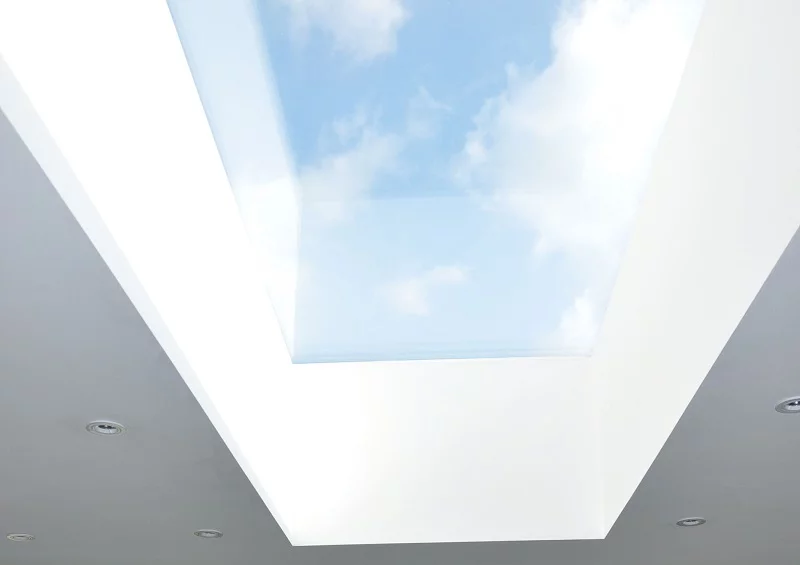
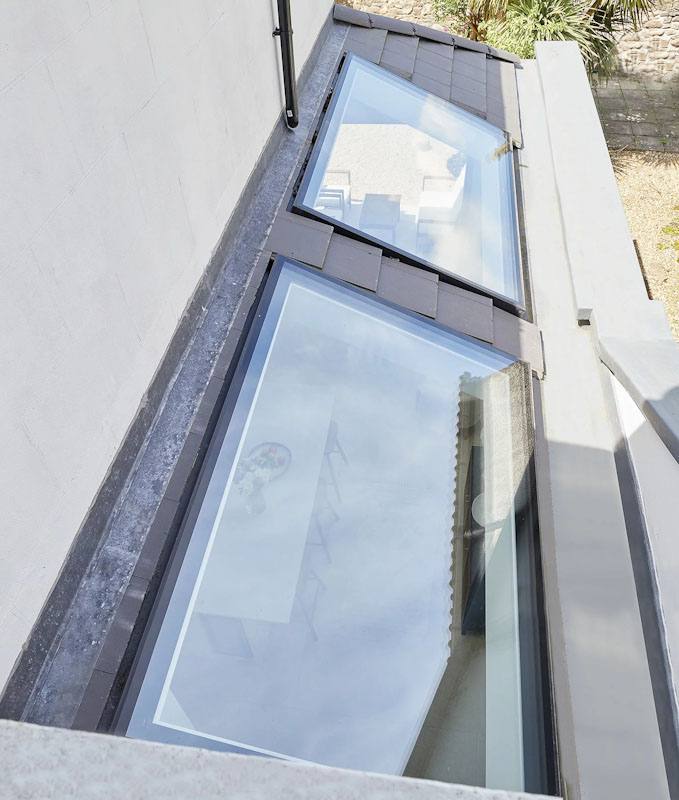
Why a rooflight is usually quieter than the roof around it
There’s a natural assumption that adding a “hole” of glass to your roof must make a room louder – that the rooflight is, by definition, the weak point in your acoustic envelope. Intuitively it makes sense: glass is solid and uniform, a roof is bulky and substantial, surely the bulky thing blocks more sound.
In practice, it usually works the other way around. A modern, well-made rooflight is often a better acoustic barrier per square metre than the roof construction surrounding it, and it’s worth understanding why – because once you see the comparison, the rest of the spec decisions make a lot more sense.
Think about how each is built. A typical UK pitched roof is a layered assembly: tiles or slates on the outside, then battens, a breathable membrane, a layer of rafters, insulation between or below them, and finally a plasterboard ceiling. Each of those layers does an important job, but together they make a system with a lot of joins, voids and gaps – places where sound can find its way through. The tiles themselves overlap rather than seal; the membrane is breathable by design; the insulation absorbs heat far better than it absorbs sound. It’s a clever piece of building physics, but it isn’t engineered primarily as a sound barrier, and it shows.
A rooflight, by contrast, is a single sealed assembly. Two or three panes of glass, bonded into a sealed unit with an inert gas filling the cavities between them, set into an aluminium frame with thermal breaks, perimeter gaskets and weather seals. There are no overlapping layers, no breathable membranes, no air paths through to the room below. The materials are denser than the equivalent area of roof construction, and the construction itself is far more uniform. Sound that would slip through the joins of a tiled roof simply has nowhere to go through a properly installed rooflight.
This doesn’t mean a rooflight makes your house quieter than it was before – the surrounding roof still does the heavy lifting acoustically, since it covers far more area. But it does mean the rooflight is unlikely to be the part of the roof that lets noise in. If anything, adding a high-spec rooflight to a section of roof often improves that section’s sound insulation rather than weakening it.
Once you’ve got that picture clear, the question stops being “how much worse will my room sound with a rooflight in it?” and becomes a much more useful one: “if I want the rooflight to perform especially well acoustically, what are the levers worth pulling?”
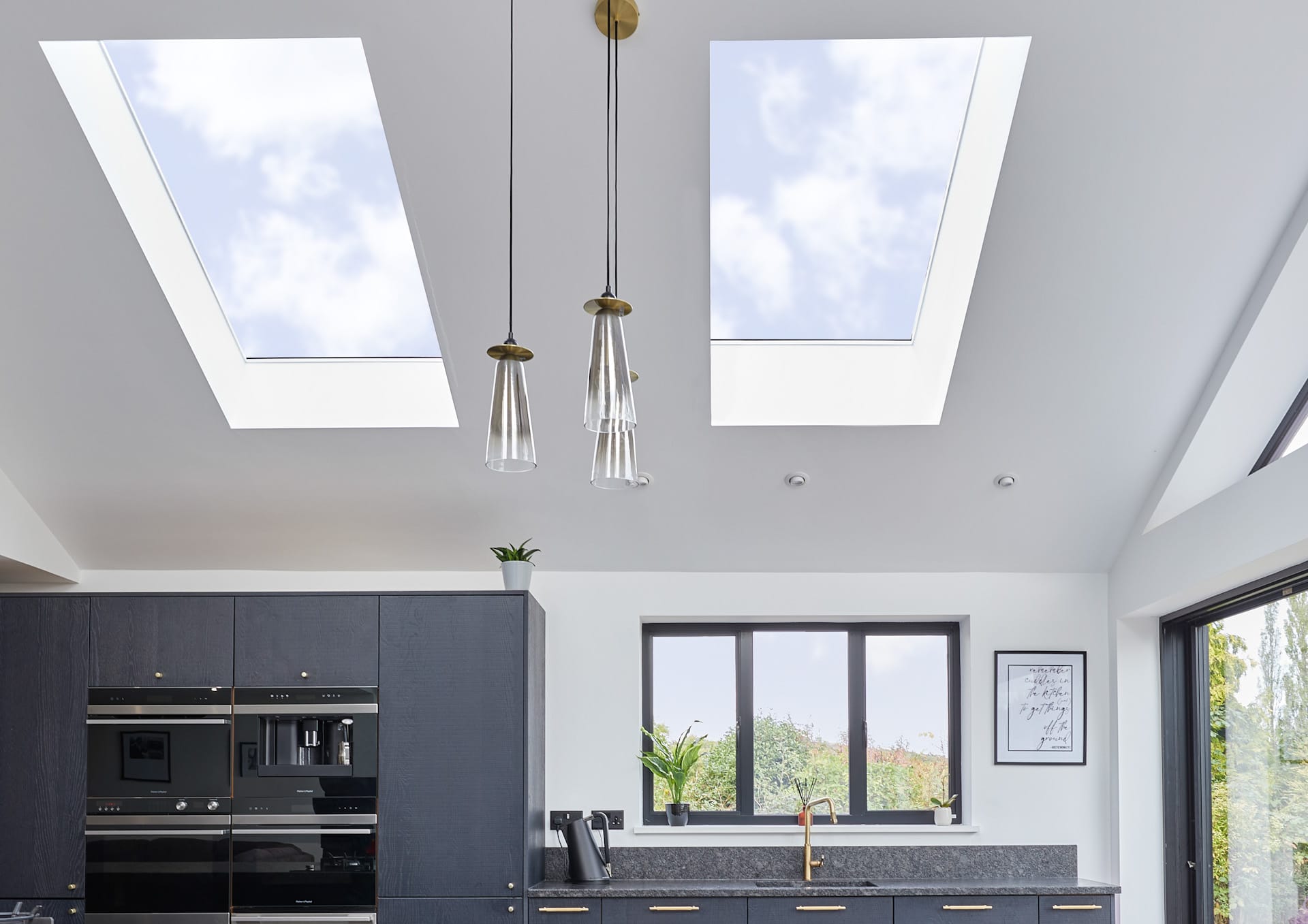
The spec choices that actually affect acoustic performance
If you do want a rooflight to perform especially well on noise, a handful of choices matter much more than the rest. Worth knowing which ones, because some carry a real cost premium and some don’t – and not all of them do equal work.
The single most useful change is the type of glass in the inner pane. Most rooflights use ordinary toughened glass throughout, which is excellent for safety and perfectly capable acoustically, but a laminated inner pane is the spec change that does the most acoustic work by a clear margin. Laminated glass is two thinner panes bonded together with a plastic interlayer, and that interlayer does something useful for sound: it dampens vibrations passing through the glass, absorbing acoustic energy that an unlaminated pane would simply transmit. This is also why laminated panes do double duty as safety glass and noise-reducing glass – the same engineering choice that protects against impact also dampens vibration. If you make one change to a rooflight specifically for noise, this is the one.
The number of panes matters too. A triple-glazed unit gives you three layers of mass and two sealed cavities for sound to negotiate, rather than two layers and one cavity. That’s more energy lost at each layer, so triple glazing is meaningfully quieter than double glazing of the equivalent build. It’s not as dramatic an improvement as adding lamination, but it’s a useful additional gain – and it stacks neatly with the lamination point above, since a triple-glazed unit with a laminated inner pane is doing both things at once.
Asymmetric pane thickness is a less obvious lever. Sound at a given frequency tends to pass more easily through two panes of identical thickness – they resonate sympathetically, a bit like two tuning forks. Using panes of different thicknesses in the same unit disrupts that, so each pane has a different “weak spot” and the unit as a whole performs more evenly across the frequency range. It’s one of the reasons our laminated glazing builds use asymmetric pane thicknesses by design – a 6mm outer pane paired with an 8.8mm laminated inner pane, so the frequencies that would slip through a symmetric unit are interrupted by the mismatch.
The cavity gas and width make a difference too, though a smaller one. Argon, which is standard in our units, is denser than air and slows the transmission of sound waves through the gap between panes. A wider cavity also helps – there’s more space for energy to dissipate before reaching the next pane. Both of these are useful contributors rather than headline changes.
Finally, the frame and the installation matter more than people realise. A rooflight is only as quiet as its weakest joint: an excellent glazing unit fitted into a poorly sealed kerb, or a frame with a thermal break that doubles as an acoustic gap, will leak sound around the edges no matter how well the glass performs. This is why the seals, the gaskets, the frame design and the on-site installation all need to be done properly – and it’s why an off-the-shelf “acoustic glass” panel slotted into a generic frame doesn’t deliver the performance the glass alone might suggest.
If you’re prioritising acoustic performance, the order of priority looks roughly like this: laminated inner pane first, then triple glazing, then asymmetric pane thickness, then everything else. Get the first two right and you’ve done most of the work.
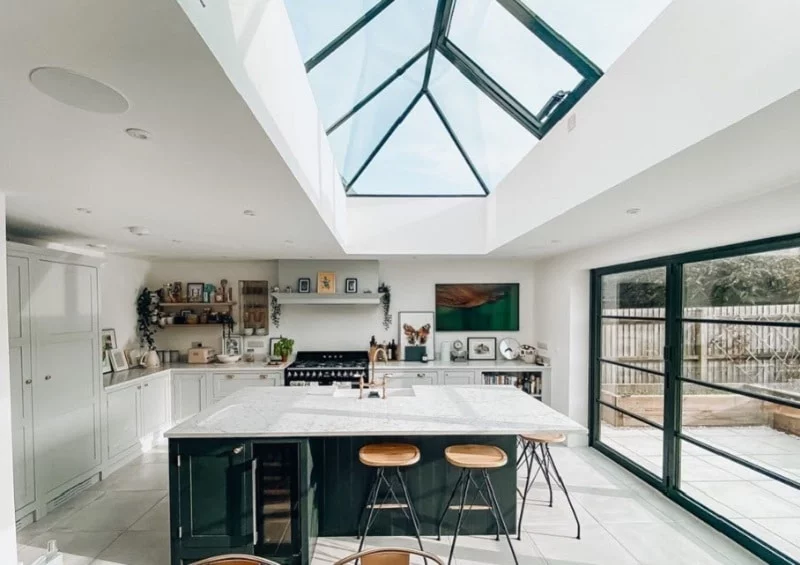
Rain noise: a different problem with a different fix
Rain on glass is its own conversation, and worth separating from the external-noise discussion above because it works differently. External noise is sound passing through the rooflight from outside the house into the room below. Rain noise is sound generated at the glass itself – every drop is a tiny mechanical impact, and the rooflight transmits the energy of those impacts directly into the room. That’s why even a glazing unit that excels at blocking external sound can still feel noticeable in heavy rain: it isn’t a failure of the seal or the build, it’s the glass acting as a sounding board for thousands of small impacts a second.
Three things make rain noise quieter or louder. The first is glass thickness and mass. A heavier pane absorbs more impact energy than a thinner one before transmitting the rest as sound, so triple-glazed units with thicker outer panes drum noticeably less than thinner double-glazed ones. The second is the same laminated inner pane that helps with external noise – the plastic interlayer dampens vibration regardless of whether the source is outside the glass or on top of it, so lamination is doing useful double duty here. The third is roof pitch: rain striking a steeply pitched rooflight hits at a shallower angle, which spreads the impact and reduces the drum effect, while rain on a near-flat rooflight strikes at close to ninety degrees and transmits more energy directly through the glass. A pitched rooflight at a typical roof angle is therefore quieter in rain than a flat rooflight of equivalent spec, all else being equal.
This doesn’t mean a flat rooflight will sound unbearable. Most people find the rain noise on a well-specified flat rooflight comfortably manageable, and many actively enjoy it – there’s a reason the sound of rain on a window is a popular sleep aid. But if you have light sleepers in the household, or a bedroom directly below a planned rooflight, it’s worth being aware that pitch and pane spec both make a real difference, and that the standard route to a quieter unit in heavy rain is the same as the route to better external noise performance: triple-glazed, laminated inner pane.
It’s also worth noting that this principle isn’t limited to traditionally pitched roofs. A roof lantern installed on a flat-roof extension gives rain a set of pitched glass surfaces to strike rather than a single horizontal pane, so it benefits from the same impact-angle effect even on a building with no pitched roof to speak of. For flat-roof extensions where rain noise is a particular concern, a Slimline® Roof Lantern or the Hinged Opening Slimline® Roof Lantern can be a quieter option than a flat rooflight of equivalent spec.
The laminate upgrade: how to specify a rooflight for noise
We don’t sell a separately-branded “acoustic” rooflight, because the spec change that delivers the acoustic benefit is one we offer as a standard glazing upgrade across our pitched and flat rooflight ranges: laminate, with toughened laminate as the higher-performance option above that. In both cases, the inner pane is laminated – two thinner panes bonded with a plastic interlayer – which is the spec change that does the most acoustic work, alongside its primary roles in safety and security performance.
Specified into one of our standard triple-glazed units, a laminated inner pane gives you the lamination’s acoustic damping effect on top of the three layers and two cavities of the triple-glazed build. That stacks the two highest-impact levers in the same rooflight, without changing anything about the frame, seals or installation – same quality control as the rest of our range, since we manufacture all our glazing units in-house.
It’s worth specifying early. If noise is a real concern for your project – a flight path, a busy road, a railway line, light sleepers in the household – telling us at the point of quoting means we can advise on whether the standard laminate or the toughened laminate upgrade is the better fit for your situation, rather than retrofitting changes later in the process.
Designing for noise as well as light
A rooflight is rarely the part of your house that lets noise in – and where it could be, the spec choices that quieten it are well understood and well within reach. Triple glazing, a laminated inner pane, the right frame and the right install: between them, those decisions do most of the work, whether you’re worried about traffic outside or rain on the glass above.
If your project sits somewhere with a real noise consideration – a flight path, a main road, light sleepers, a home office that doubles as a recording space – the most useful thing you can do is mention it early. Our team can talk through whether the standard laminate or the toughened laminate upgrade is the right fit for what you’re trying to achieve, and how it sits alongside the other specification choices you’re making. Take a look at our full range of rooflights, or give us a call on 0116 269 6297.