
All of that is real – and it matters. But here’s what often surprises people after the installation: what happens after dark.
A rooflight doesn’t switch off when the sun goes down. If anything, it changes the character of a room entirely. The ceiling becomes a window onto something vast and beautiful – a slow-moving moon, a scattering of stars, or even just the deep blue of a clear winter evening. And with the right blind in place, you control when you want that view, and when you want total darkness.
This post is about that other half of the rooflight experience: the evenings, the nights, and what it feels like to live under the sky 24 hours a day.
A window to the night sky
Most of us are surprisingly disconnected from the night sky. Light pollution, drawn curtains, and the warm glow of screens means that for many people, the stars are something you only really notice on holiday – standing in a dark car park somewhere in the countryside and remembering, with a slight shock, just how many of them there are.
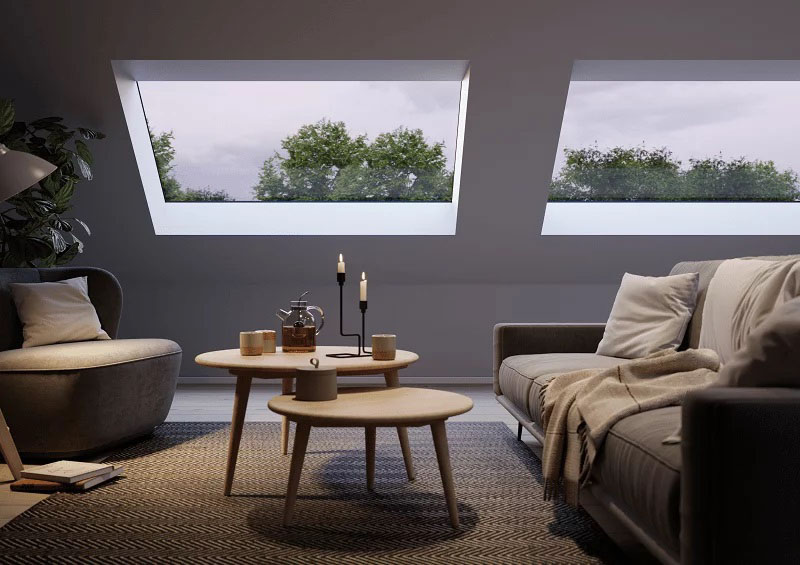
A rooflight changes that relationship. When you’re lying on the sofa with a large fixed flat rooflight above you, or tucked into bed beneath a Luxlite® on a pitched roof, the stars aren’t something you have to seek out. They’re simply there – part of the room, part of the evening.
The research backs up what most stargazers already know instinctively. A study published in 2024 in the Journal of Environmental Psychology found that people with a greater connection to the night sky reported better mental health and greater happiness. BBC Sky at Night Magazine has written about what astrophysicist Mark Westmoquette calls ‘star bathing’ – the idea that spending time under the open sky, even passively, has a measurable calming effect, reducing stress and shifting attention away from everyday anxiety.
You don’t need a telescope. You don’t need to know a constellation from a nebula. You just need a clear pane of glass and somewhere comfortable to sit.
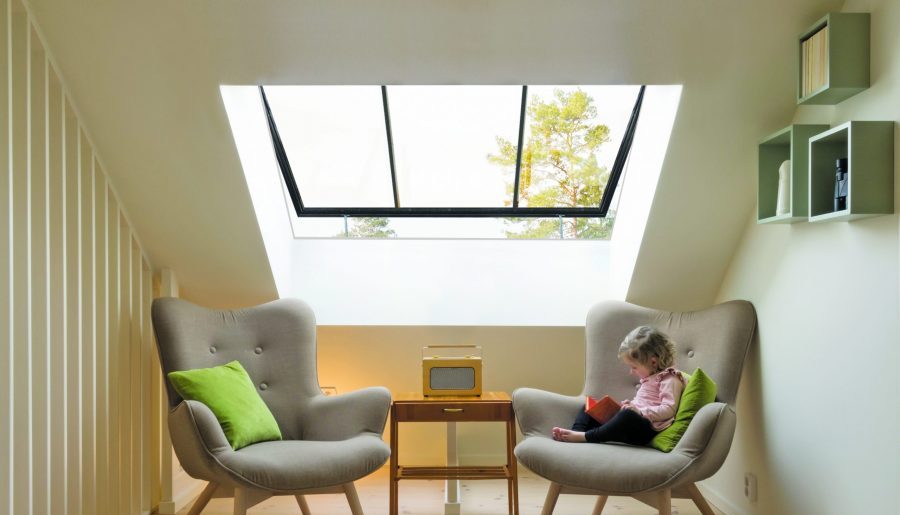
For the clearest, most uninterrupted view, a fixed flat rooflight is hard to beat. The frameless appearance from the inside means there’s nothing to interrupt the view – just glass and sky. Roof lanterns offer a broader panorama thanks to their angled panes, which capture a wider sweep of sky from multiple directions. And for pitched roofs, the Luxlite®’s frameless internal finish maximises the glass area, so the view is as open as possible.
Room by room: where the magic really happens
The night sky experience isn’t the same in every room — and that’s part of what makes it so interesting to think about when you’re planning where to install.
In a kitchen or open-plan living space, a rooflight above the dining table or island becomes a conversation piece in the best possible sense. There’s something quietly spectacular about eating dinner under the stars, or sitting with friends long after the plates have been cleared, watching clouds drift across a bright moon. During the day the rooflight does the practical work of flooding a busy space with light; in the evening, it earns its keep in a completely different way.
In a bedroom, the effect is more intimate — and the science behind it is genuinely compelling. Research published in the Proceedings of the National Academy of Sciences, based on a study of UK adults, found that higher exposure to natural light during the day combined with lower light levels in the evening and night is directly associated with better sleep quality and earlier, more consistent sleep timing. A rooflight that lets you track the gradual darkening of the sky — without the blue-tinted glare of a screen — is working with your body’s natural rhythms rather than against them. And waking up to natural morning light, rather than an alarm in an artificially dark room, is something that’s genuinely difficult to describe until you’ve tried it.
In a bathroom, a rooflight above a bath or walk-in shower creates the kind of atmosphere that usually costs a lot of money in a spa. The privacy question is easily solved (more on that below), but the experience of soaking in a hot bath while looking up at a night sky — even a cloudy one, with its soft ambient glow — is one of those small domestic pleasures that quietly improves your day.
Light control: because sometimes you want the dark
Here’s the part that surprises some people: having a rooflight above your bedroom doesn’t mean waking up at 4am in midsummer because the sky is already bright. And having one in your bathroom doesn’t mean trading privacy for a sky view.
The answer is the Sky-Blind – and it changes the whole equation.
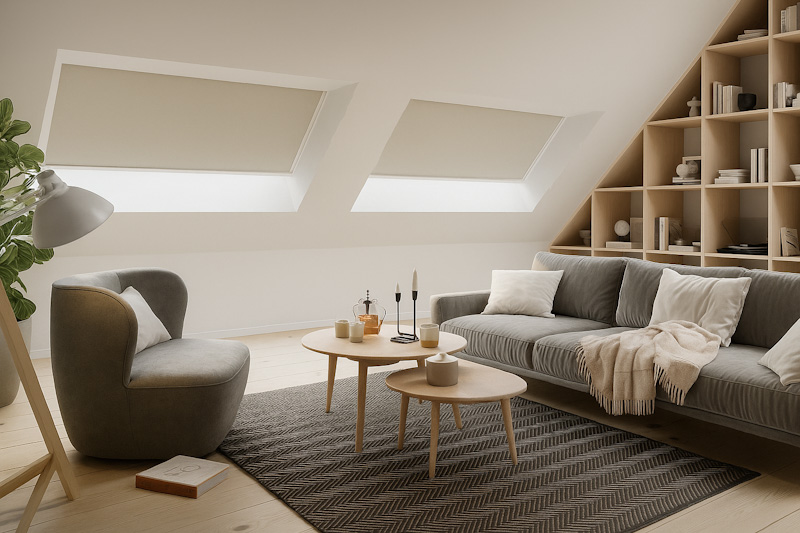
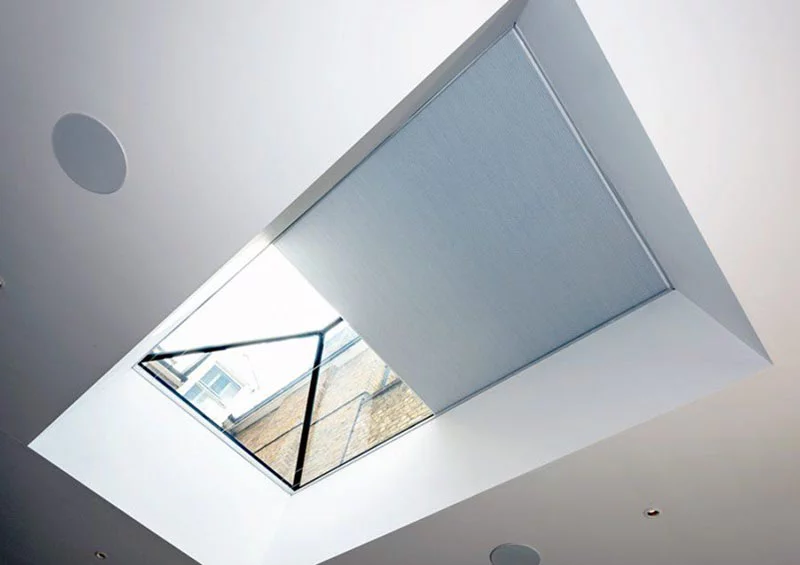
Sky-Blind electric blinds are designed specifically for rooflights and roof lanterns. There are no visible cords, no awkward mechanisms – just a clean, minimal blind that opens and closes via a wall switch, remote control, or smart home integration. They fit inside the rooflight frame, which means they don’t interrupt the aesthetic of the room when they’re open.
For bedrooms, the blackout option means complete darkness on demand. Research published in ScienceDirect (2025) found that controlled exposure to natural light before waking — letting the morning in gradually rather than all at once — improved alertness and reduced sleep inertia. A motorised blind makes that easy: programme it to open slowly as your alarm goes off, and let the morning do the waking for you.
For bathrooms, a Sky-Blind gives you the sky view when you want it and full privacy when you don’t. Open it for your evening bath; close it before you turn the light on.
The other benefit that’s easy to overlook: a closed blind in a bedroom on a summer night keeps streetlights and urban glow out entirely, creating the kind of genuine darkness that’s increasingly rare in UK homes. The Sleep Foundation is clear on this point — making your bedroom as dark as possible is one of the most effective things you can do to improve sleep quality. A blackout blind on your rooflight is the most elegant way to achieve it.
The practical side (briefly)
A night sky view is all well and good, but it needs to work year-round in the British climate — and here’s where quality glazing genuinely earns its place.
Our triple-glazed rooflights maintain a comfortable internal temperature even on cold winter evenings, which means no cold spots above the bed or a chill dropping from the glass above the dining table. You can look up at a frosty January sky without your room temperature telling you about it.
Easy clean glass coating — which uses a photocatalytic reaction to break down dirt particles and lets rainwater rinse the surface clean — means the view stays clear without you having to get on the roof every few weeks. A rooflight that’s gradually clouded by grime loses most of its magic; ours is designed to stay as clear as the day it was installed.
And for summer evenings, our opening rooflights do something no ordinary window can quite match — they let the warm night air in from above, creating a natural flow of ventilation that makes a kitchen or living space feel genuinely alive. Close them before you go to bed, or let the built-in rain sensor do it for you if the weather changes.
Something worth looking up for
We spend a lot of time looking at screens and not much time looking at the sky. That’s not a judgement — it’s just the way most homes are built, with walls and curtains and ceilings that point us inward.
The Mental Health Foundation has written about the importance of ‘everyday nature’ — not grand trips to remote landscapes, but small, consistent moments of connection with the natural world close to home. Looking up at the sky from your own sofa on a Tuesday evening counts.
A rooflight is, at its core, a very simple thing: a pane of glass in your ceiling. But what it does to the texture of daily life — the quality of the light in the morning, the atmosphere of an evening with friends, the quietness of lying in bed watching stars — is anything but simple.
If you’d like to explore which of our products would work best in your home, browse our full range or visit our showroom. Our team are always happy to talk through the options — day or night.